Selection Guides
Planetary Gearbox Selection for Packaging Machinery
Six selection factors for packaging machinery gearboxes: inertia matching, peak torque, ratio against line speed, backlash grade by station, radial load, and hygiene requirements.
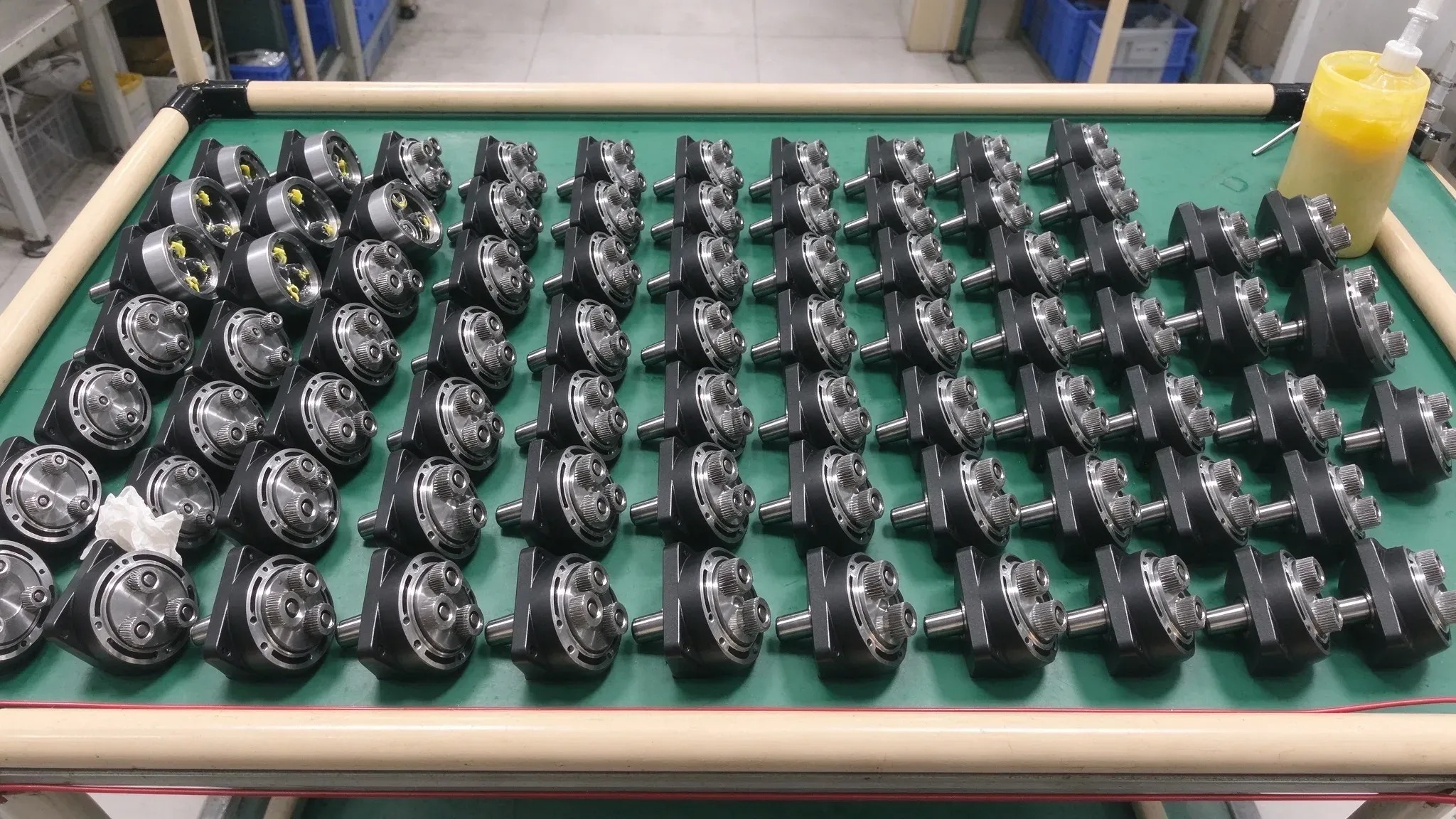
Modern packaging machinery keeps moving toward higher speed, tighter accuracy and faster cycles. Whether it is a flow wrapper running several hundred packs per minute, a rotary filling and capping machine, or a flying-shear labeler, positioning accuracy and response speed decide yield and throughput.
The planetary gearbox sits between the servo motor and the mechanism. It multiplies torque, matches load inertia and damps motion ripple. Specify it badly and the machine shows it: misaligned seals, cutter collisions, motor overheat alarms, stripped gear teeth or a broken shaft.
This guide covers six selection factors that come up in real packaging projects.
What packaging stations actually demand
Every station inside a packaging machine behaves differently, so the gearbox has to be matched to the specific motion rather than to the machine as a whole.
Flow wrapper and vertical form-fill-seal (VFFS/HFFS), sealing and cutting jaw shaft plus film feed shaft — high cycle rate with continuous start-stop, acceleration and deceleration measured in tens of milliseconds, and strong reverse impact. Needs very high torsional rigidity, high peak torque capacity and low backlash so the cutter stays in phase without pulling the film.
High-speed labeler, rotary label feed and wipe-on mechanism — fast response, tight servo following, frequent acceleration, tension fluctuation. Needs ultra-low backlash of 3 arcmin or less, low cogging torque and very low running noise so the label stays flat and the positioning error stays under 0.2 mm.
Rotary filler and capper, turret indexing and capping spindle — large inertia rotating load, precise multi-station stopping, and possible liquid splash. Needs a high ratio, high radial and axial load capacity, IP65 protection and a food-grade sealing arrangement.
Cartoner, case erector and palletizing robot — Cartesian or linkage mechanism, long reciprocating travel, belt or rack-and-pinion drive. Needs high bending stiffness, large radial force capacity and long-life maintenance-free lubrication.
Six selection factors
Factor one: inertia matching.
A common problem on packaging servos is that raising the gain produces oscillation and lowering it produces lag. The usual cause is the ratio between load inertia reflected to the motor shaft and motor rotor inertia. Reflected inertia falls with the square of the ratio, so a well-chosen ratio is what makes a fast servo response possible without overshoot.
For high-speed start-stop mechanisms such as flying shear and film feed, aim for a reflected inertia ratio of 3:1 to 5:1. Continuous drives can often go to 10:1.
Factor two: check both torque figures.
Do not size the gearbox from motor power alone. Verify the continuous rated output torque against the steady resistance at maximum running speed, taking the duty cycle and service factor into account.
Then verify the peak torque for acceleration and emergency stop. Packaging machines reach full speed in 50 to 100 ms, and the resulting inertia torque is large. The permitted maximum acceleration torque, typically 1.5 to 2 times the rated torque, has to exceed the worst transient, and the emergency stop torque has to satisfy the braking case.
Factor three: ratio against line speed.
The ratio sets both output torque and the motor's operating point. A servo runs most efficiently and cools best near its rated speed, usually around 3,000 rpm.
Too small a ratio leaves the motor running slowly, hot and short of torque. Too large a ratio can run into the gearbox's maximum permitted input speed, which then caps the machine's packaging speed.
Factor four: backlash grade by station.
Backlash affects how well the finished pack aligns. Precision grade of 1 to 3 arcmin suits cutter phase synchronization, rotary die cutting and high-accuracy labeling, where the axis reverses and positions precisely. Standard grade of 5 to 8 arcmin suits continuous one-way rotation such as chain conveyor, film feed roller and cartoner auxiliary mechanisms.
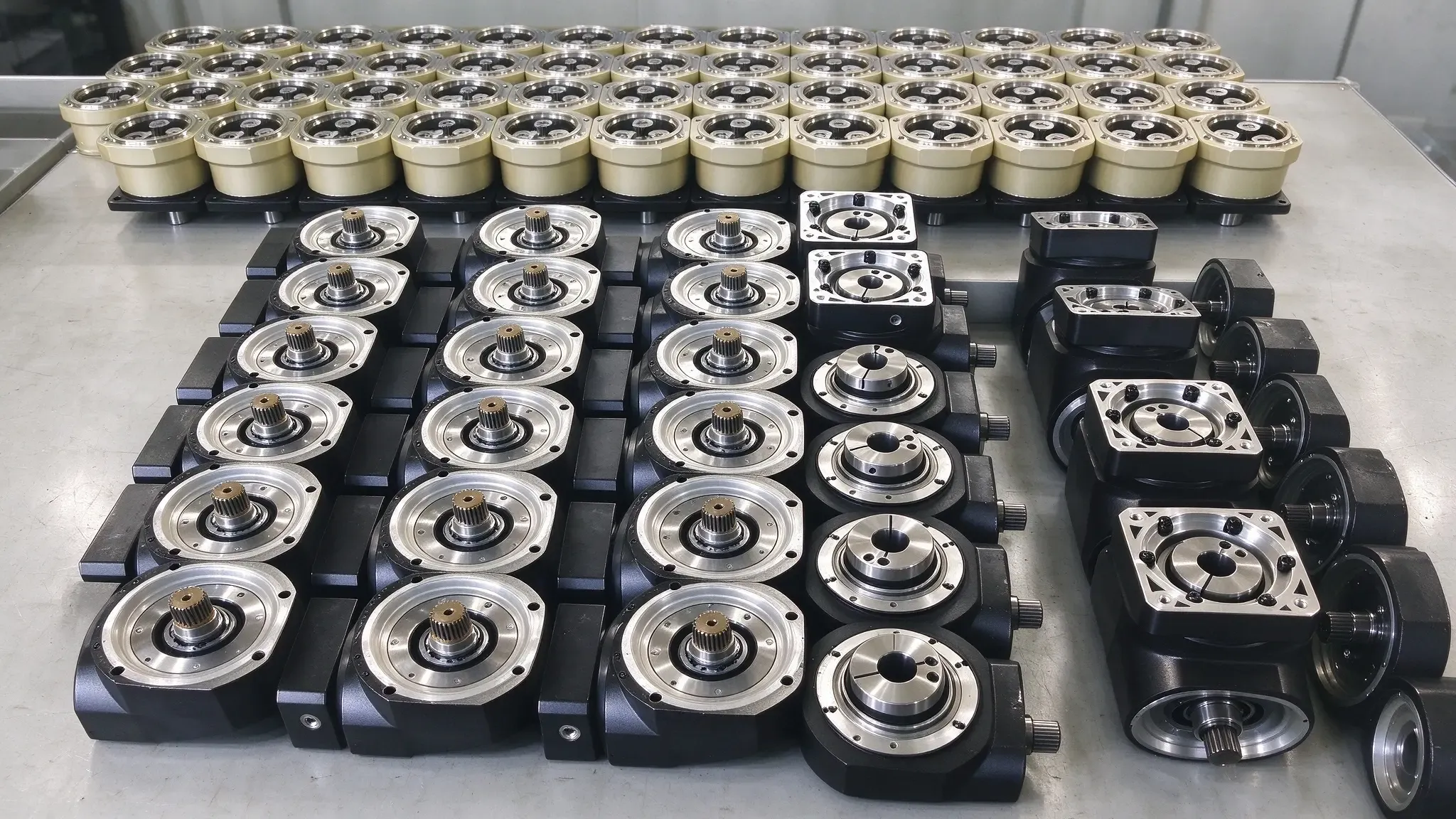
There is no need to fit the whole machine with the most expensive grade. Grading by station gives the best cost balance.
Factor five: radial and axial load at the shaft.
Packaging machines commonly drive through timing pulleys, sprockets or a direct gear connection, and those components put large side loads on the output shaft. If the bearing span is too short or the bearing grade too low, long-term radial pull leads to oil seal leakage, shaft fatigue and eventually bearing failure.
A stiff wide-span bearing arrangement on the output side is what carries large cantilever radial loads.
Factor six: environment, hygiene and lubrication.
Dust and powder lines need IP65 sealing. Liquid filling and washdown areas need resistance to spray and a corrosion-resistant coating.
For food and pharmaceutical equipment, food-grade synthetic grease to NSF H1 is the usual specification, together with a sealed-for-life design that removes the risk of grease leaking into the product.
Helical or spur?
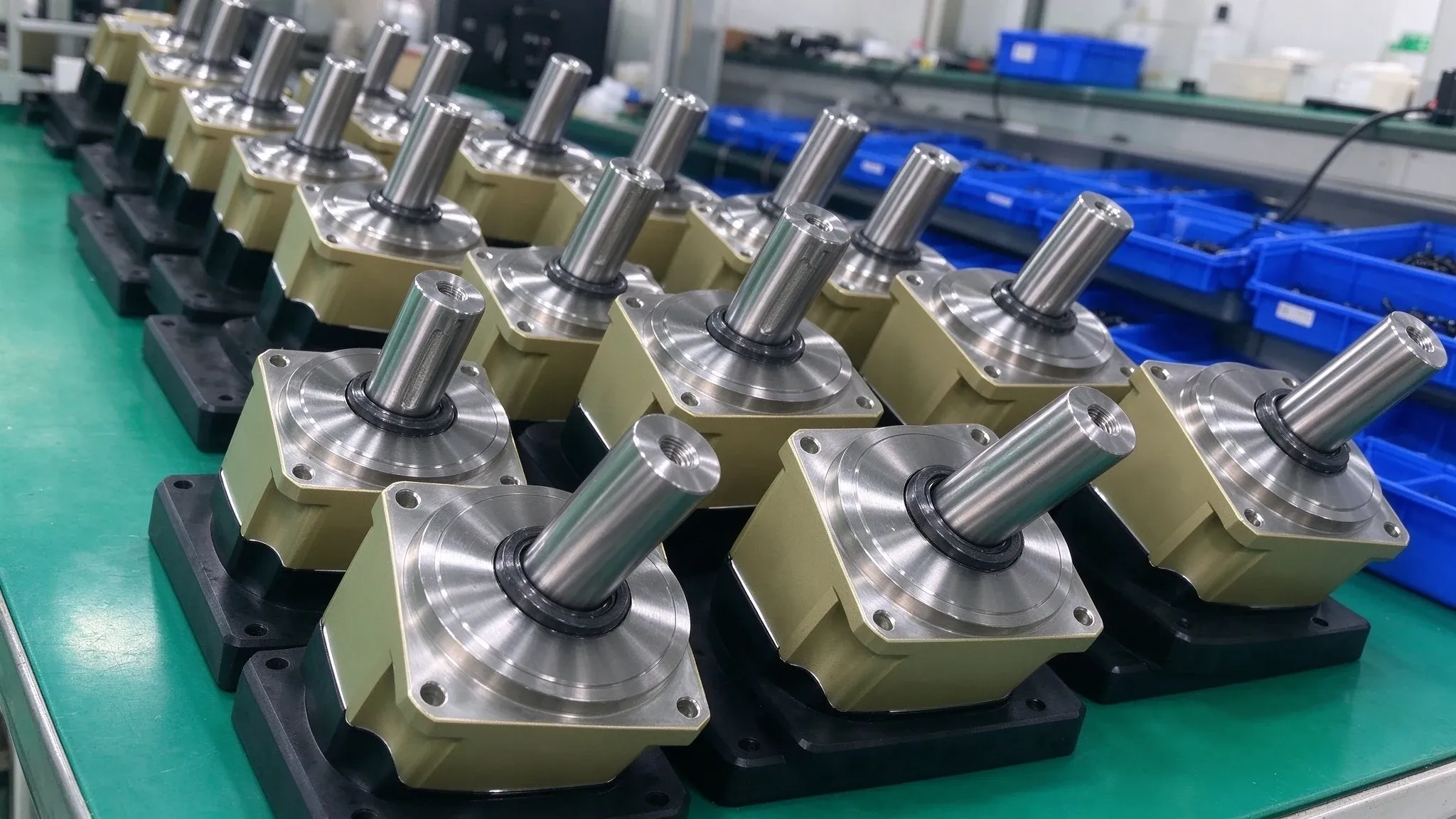
In a full machine design the practical answer is usually a mixed layout: helical where the motion is fast and reversing, spur where the motion is simple and slow.
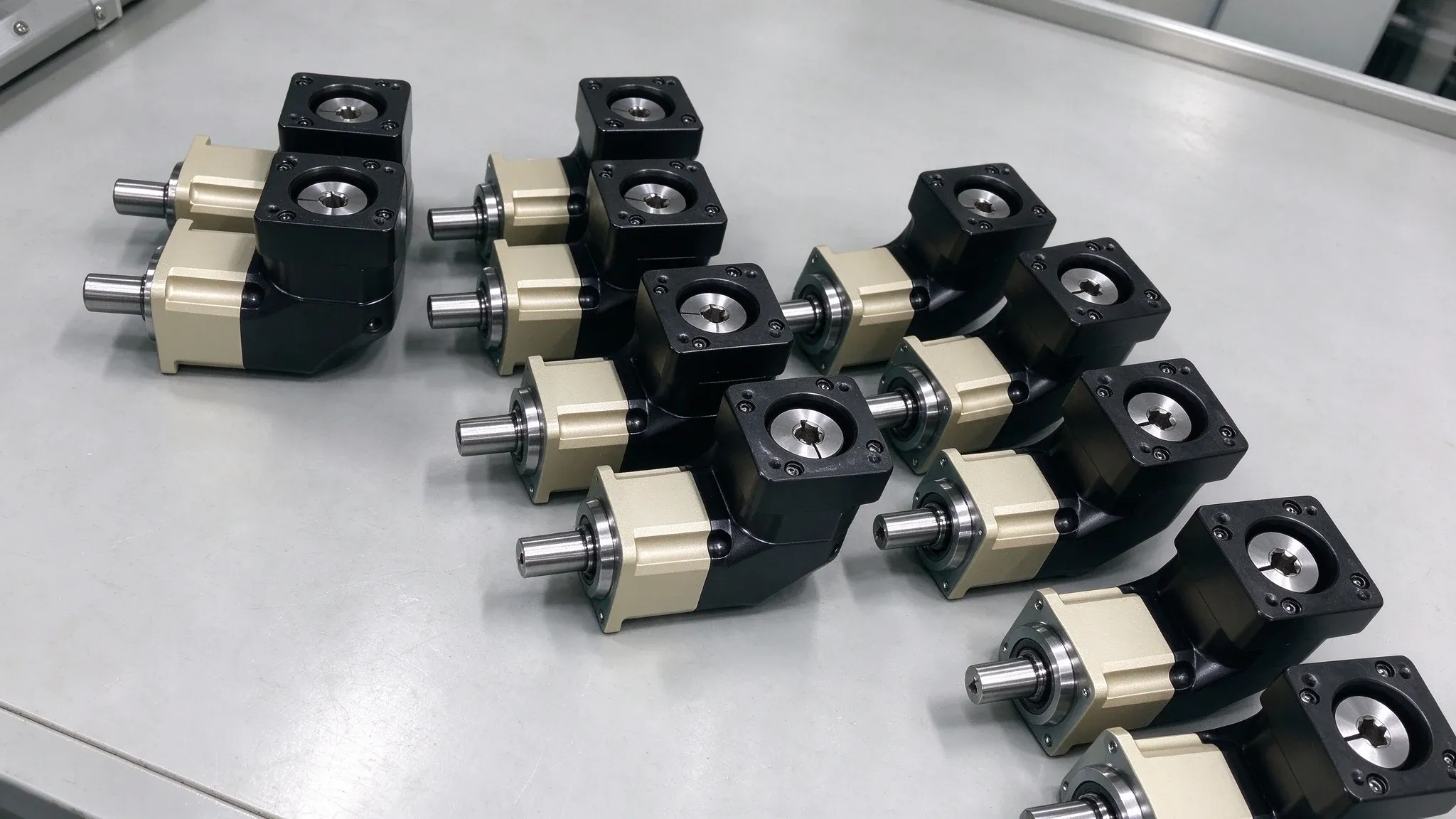
High-speed rotary sealing and cutting, flying shear — helical, precision grade 3 arcmin or less. Gradual multi-tooth mesh, high impact stiffness, low vibration, clean cut.
High-speed label feed and application — helical, precision grade 3 arcmin or less. Very smooth and quiet, low cogging, fast response with no lag.
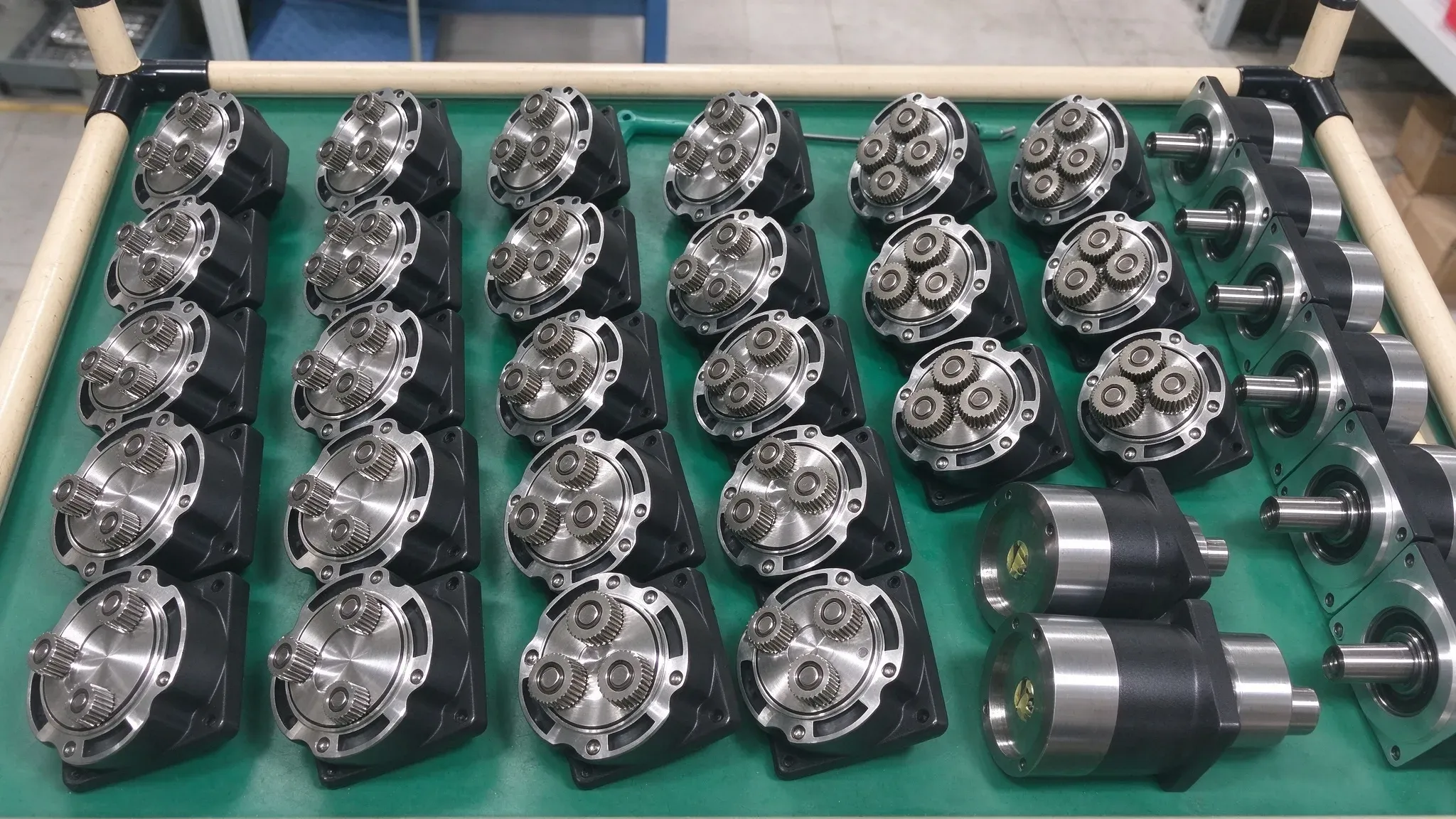
Film feed roller, servo feed shaft — helical or precision spur, standard grade 5 to 7 arcmin. One-way continuous running; smooth torque transmission and high radial load matter most.
Multi-station turret filling and indexing — heavy-duty helical or flange output, precision grade 3 arcmin or less. Flange output resists tilting moment and holds position with large inertia.
Tray lift, guard rail width adjustment — spur, economy grade 10 to 12 arcmin. Simple structure, low speed, cuts the bill of materials on series production.
If you want to compare the helical side of that layout in more depth, the precision helical planetary gearbox options cover the precision grades used on sealing, cutting and labeling axes.
A typical starting point for a 3 arcmin precision axis is the DB precision helical planetary gearbox. For the auxiliary axes where a simple, low-cost drive is enough, the spur planetary gearbox alternatives are the more economical route.
How to judge a gearbox supplier
For an automation OEM, choosing a gearbox means choosing engineering support as much as hardware. Four things are worth checking.
Motor flange matching — can the supplier provide adapter plates across the full range, so Panasonic, Inovance, Yaskawa, Siemens and Delta motors mount without modification?
CAD model delivery — can the standard 3D models be obtained quickly enough to drop into a SolidWorks or AutoCAD assembly without redrawing them?
Test discipline — is every unit checked before shipment for noise level, backlash and run-in temperature rise, rather than sampled?
Lead time and customisation — are standard models held in stock, and can output shaft extension, keyway, dowel pin hole and anti-corrosion coating be customised?
Common questions and next step
What causes stripped teeth or a broken shaft on a high-speed packaging cutter?
Three causes recur. The transient peak torque during acceleration was never properly calculated, so the safety margin is too thin. A jam or cutter collision produced a torque spike with no safety clutch to absorb it. Or the planet gear material and heat treatment hardness fall short of the application.
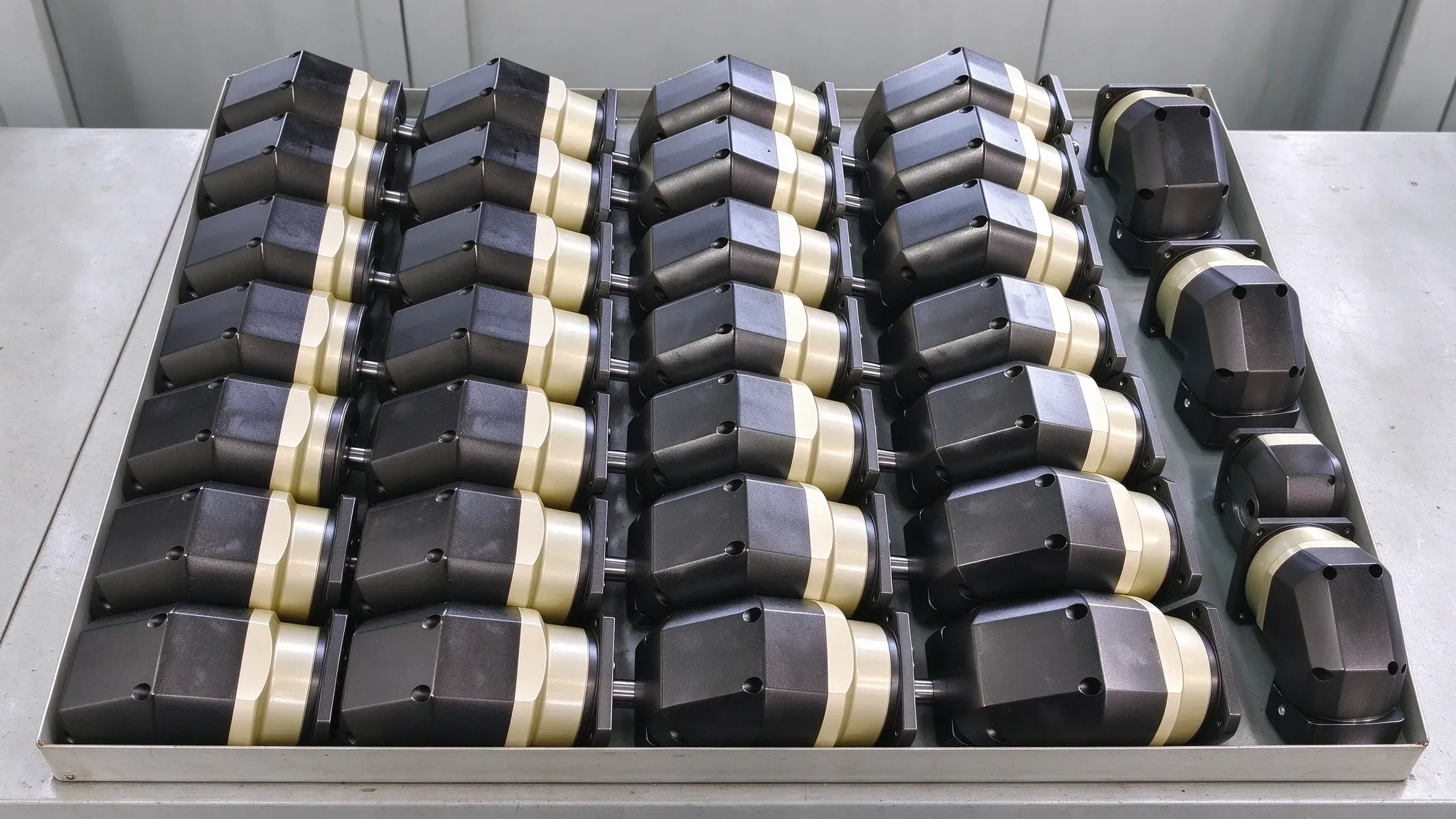
A carburised and hardened helical gearbox in 20CrMnTi alloy steel handles momentary impact better.
Why does torsional rigidity matter so much on packaging machinery?
Under high-frequency reversing start-stop, a gearbox with insufficient torsional rigidity behaves like a torsion spring. When the axis brakes to a stop at speed, the drivetrain rebounds elastically and the mechanism shakes, which shows up as a label drifting off position or a seal cut out of line.
Are food-contact grade gearboxes available?
Yes. For food and pharmaceutical packaging equipment, food-grade fully synthetic grease to NSF H1 can be specified, together with double-lip fluoroelastomer seals and either stainless steel or chemically plated surfaces.
If you are developing a new packaging machine or reworking an existing drive train, send us the cycle time requirement, the servo motor model and the load drawing through our contact page. Our application engineers will check the motor and gearbox as a matched system and come back with a selection recommendation and drawings.
Final values are always confirmed against the product datasheet and the real operating conditions.