Selection Guides
Helical vs Spur Planetary Gearbox: Which One Fits?
Spur or helical planetary gearbox? Compare tooth engagement, contact ratio, noise, axial thrust, backlash and cost, and see which tooth form matches your machine.
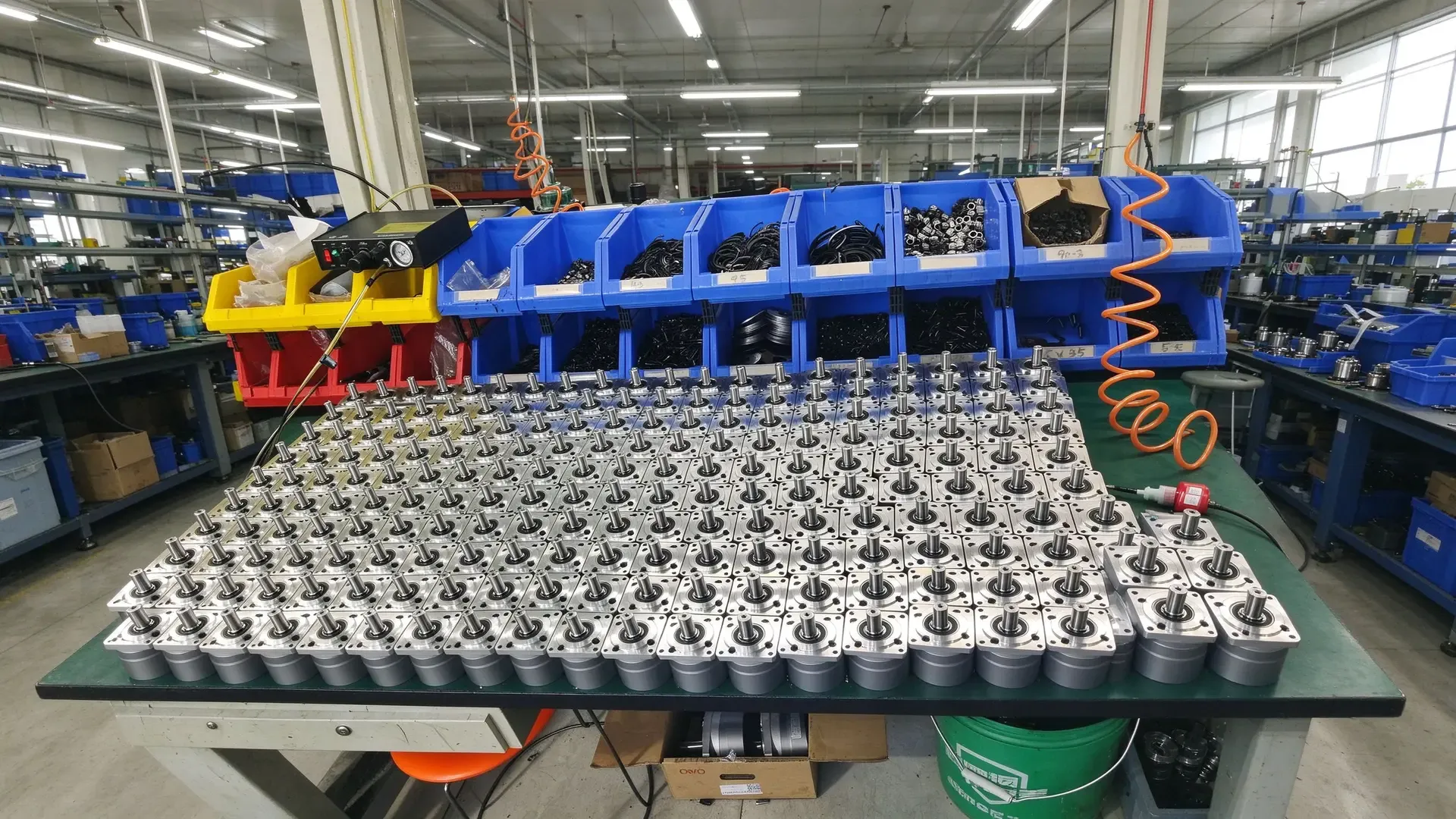
Planetary gearboxes are common in industrial automation and servo drive systems because they are compact, efficient and carry high torque density. At the specification stage, engineers run into the same question: spur or helical?
Both types match a motor, reduce speed and multiply torque. What separates them is how the gear teeth engage, and that determines noise, running smoothness, dynamic response and manufacturing cost.
This guide covers the internal mechanism, the practical performance differences and the applications each type suits.
What is a spur planetary gearbox?
A spur gear has teeth parallel to the axis of rotation. During mesh, the full tooth width enters and leaves contact at the same moment.
How it works — all teeth contact at once, so power transmits directly and quickly. In theory the tooth flanks produce no axial thrust, which keeps the internal bearing arrangement simple.
Manufacturing — gear cutting and inspection are mature processes, so standard-ratio models offer a clear cost advantage.
Limitation — simultaneous contact produces repeated impact pulses. At high input speeds, roughly above 2,500 rpm, or under heavy load, that shows up as noticeable noise and slight vibration.
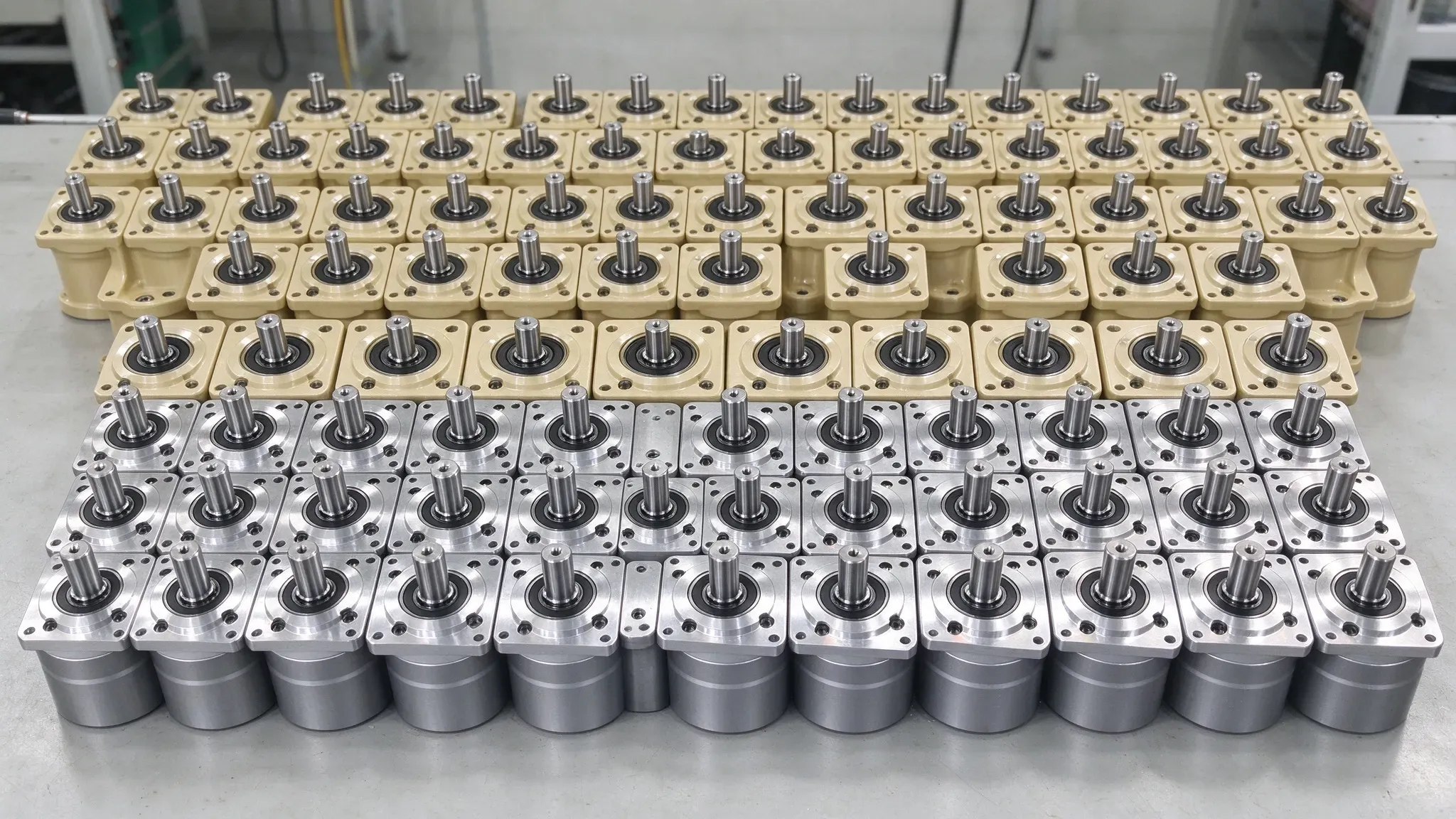
What is a helical planetary gearbox?
A helical gear has teeth set at a helix angle. As the gear rotates, the contact line slides gradually from one end of the tooth to the other instead of engaging all at once.
Higher contact ratio — helical gears typically have a contact ratio 30 to 50 percent higher than spur gears, so a longer effective tooth length shares the load at any instant and the running impact is much smoother.
Lower noise — helical units stay noticeably quieter under servo operation at 3,000 to 6,000 rpm. Published noise figures depend on speed, load, measurement distance and mounting rigidity, so compare values measured under the same conditions and confirm against the datasheet for the specific model.
One design consequence — helical mesh generates axial thrust. Carrying this load needs angular contact or reinforced bearing arrangements and a stiffer planet carrier, which is why helical units cost more to build.
Spur vs helical: the direct comparison
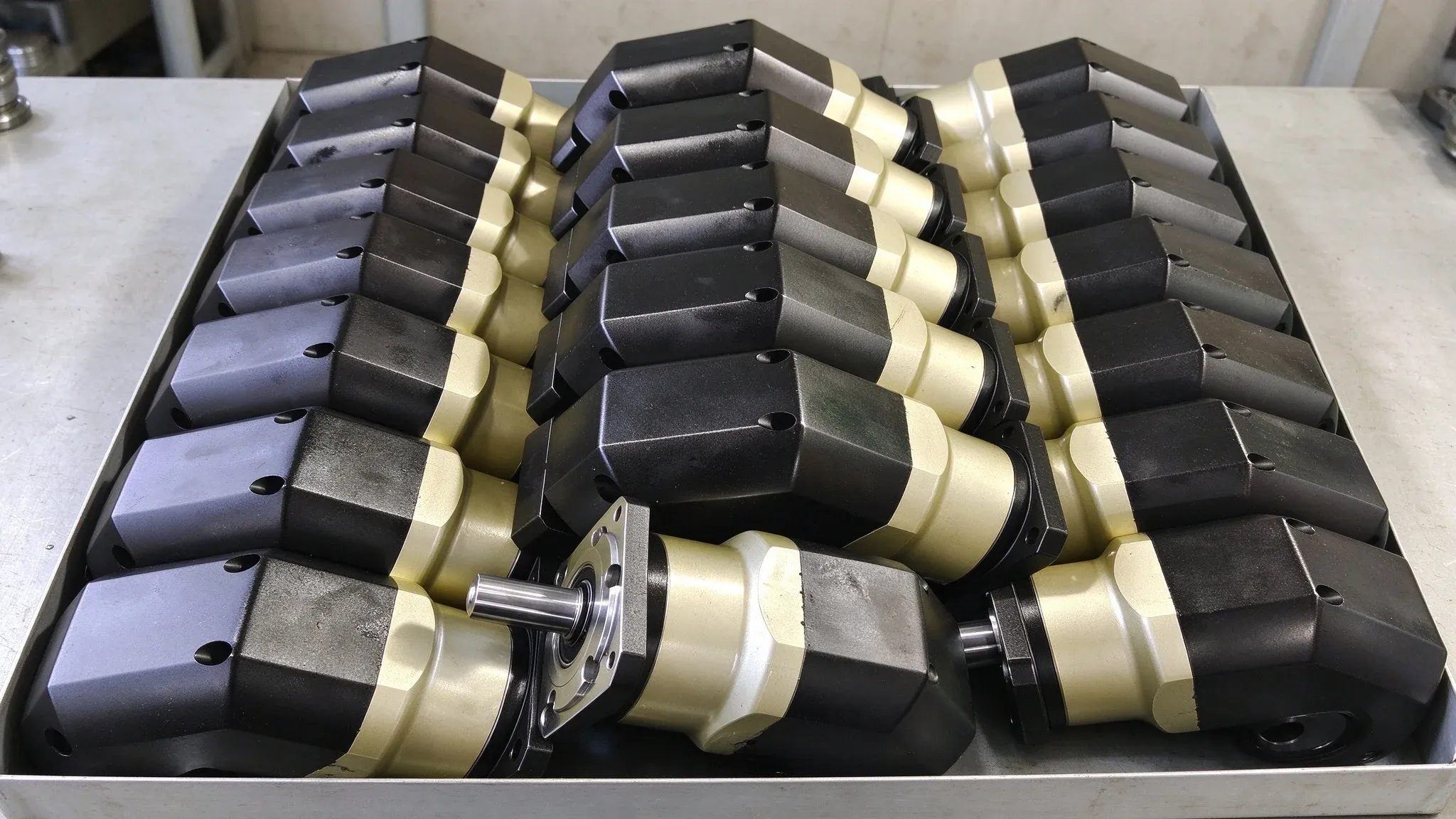
The table below covers the dimensions that decide most selection calls.
Tooth engagement — spur: full face contact at once, pulsed. Helical: gradual sliding contact along the helix.
Contact ratio — spur: baseline. Helical: roughly 30 to 50 percent higher effective contact length.
Noise and vibration — spur: noticeable at high speed or heavy load. Helical: quieter across the speed range, with the advantage most visible above 3,000 rpm.
Torque capacity — spur: standard rating, moderate resistance to repeated shock loading. Helical: better able to absorb transient peak torque and longer fatigue life under reversing loads.
Axial force — spur: essentially none, so bearing load is almost purely radial. Helical: axial thrust is generated and has to be carried by the bearing design.
Backlash — both types come in multiple grades. Tooth form does not set the backlash value, so compare the actual arcmin figure rather than assuming helical is tighter.
Cost — spur: lower initial investment. Helical: higher gear cutting and bearing requirements raise the unit price.
Three misconceptions about spur and helical
Myth one: helical always has lower backlash.
Not true. Backlash depends on the gear grinding or hobbing accuracy grade, the carrier centre distance tolerance and the assembly shimming process. A precision spur planetary gearbox can hold under 3 arcmin, while a standard-grade helical unit may sit in the 8 to 12 arcmin range. Specify from the actual figure in the datasheet, such as a precision grade or a standard grade.
Myth two: helical is much less efficient than spur.
Not in practice. Helical mesh does introduce a small axial force component and some sliding between tooth flanks, but with proper lubrication and precision manufacturing the difference is small. Single-stage efficiency lands around 96 to 97 percent for helical and 97 to 98 percent for spur, which is negligible for most applications.
Myth three: spur is only good enough for cheap equipment.
Spur gears are simple, rigid and run cool. In medium-speed constant-speed machinery where acoustic performance is not critical, they are reliable and cut the bill of materials on high-volume builds. Choosing spur is an engineering decision, not a compromise.
Which type suits your machine?
Helical is usually the better fit for:
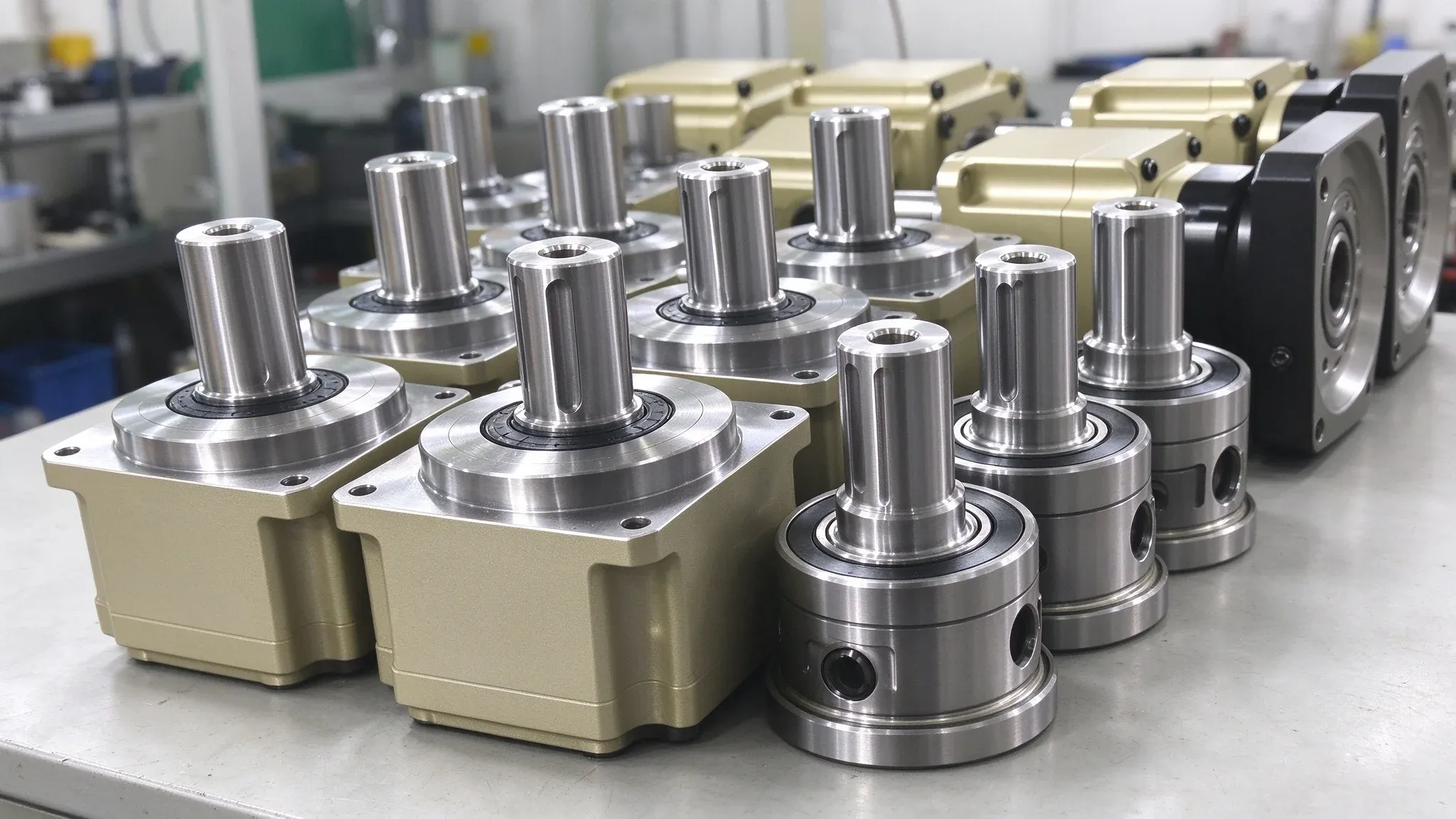
CNC machine tools and laser cutting, where feed axis smoothness, chatter resistance and dynamic repeatability all matter.
Industrial robots and cobots, where high torque density, frequent acceleration and reversing, and low backlash are required together.
Medical equipment, laboratory instruments and semiconductor lines, where noise and micro-vibration are tightly controlled.
Continuous high-speed servo mechanisms running above 3,000 rpm, where heat and service life are the constraint.
Spur is usually the better fit for:
Conveyors and automated warehouse sorting, where running speed is moderate and batch purchase cost dominates.
Packaging machinery and print finishing equipment, with intermittent feed and open-close motion and normal tolerance for noise.
Stepper motor applications and secondary automation axes such as lift mechanisms and width adjustment, where the axis is not the main positioning axis.
Neither type is better in general. Match the tooth form to the machine.
Seven parameters to prepare before asking for a quote
Having these ready shortens the review and avoids a round of back-and-forth.
1. Ratio — calculated from motor speed and required output speed.
2. Output torque — both continuous rated torque and the peak torque at acceleration or emergency stop.
3. Backlash grade — chosen from the positioning tolerance of the end equipment.
4. Input speed — the motor's rated speed plus the maximum permitted momentary input speed.
5. Radial and axial load — if the output drives a timing pulley or a rack and pinion, check the permitted radial force at the shaft end.
6. Motor flange interface — shaft diameter, pilot boss size and bolt circle diameter, so the input flange can be matched.

7. Duty and environment — daily running hours as a duty cycle percentage, start-stop frequency, ambient temperature and required ingress protection.
Common questions and next step
Can spur and helical units be swapped directly?
At the same frame size and ratio, they can usually be exchanged if the mounting flange, shaft diameter and keyway match. Check the difference in torque capacity and noise, though. Replacing a helical unit with a spur one means verifying the shock load and the noise limit still work for the machine.
Which type lasts longer with a servo motor?
Service life depends mainly on load ratio, duty cycle, gear heat treatment and bearing lubrication. With enough torque margin, commonly a safety factor of 1.5 to 2.0 against the application load, both types reach a long rated life. Helical gears generally handle frequent shock and high-speed reversing loads better over time.
Can the flange and shaft be customised?
Yes. Modular input adapter plates cover the common servo brands, including Panasonic, Yaskawa, Mitsubishi, Inovance, Delta and Siemens. Output shafts can be supplied with a keyway, as a plain shaft, with a spline or as a flange output.
Choosing between helical and spur starts with the noise target, the duty cycle and the positioning requirement, then moves to ratio, torque and motor interface. If you have the motor model, the target ratio and the load conditions, send them through our contact page and we will review the selection against your drawings.
You can also compare the two families directly: helical planetary gearboxes and spur planetary gearboxes.