Oct 28, 2026Selection Guides
How to Choose Planetary Gearbox Backlash: 1, 3 and 5 Arcmin
How to pick 1, 3 or 5 arcmin backlash for a planetary gearbox: the lost-motion principle, end offset on a cantilever, and when tighter backlash is not worth the cost.
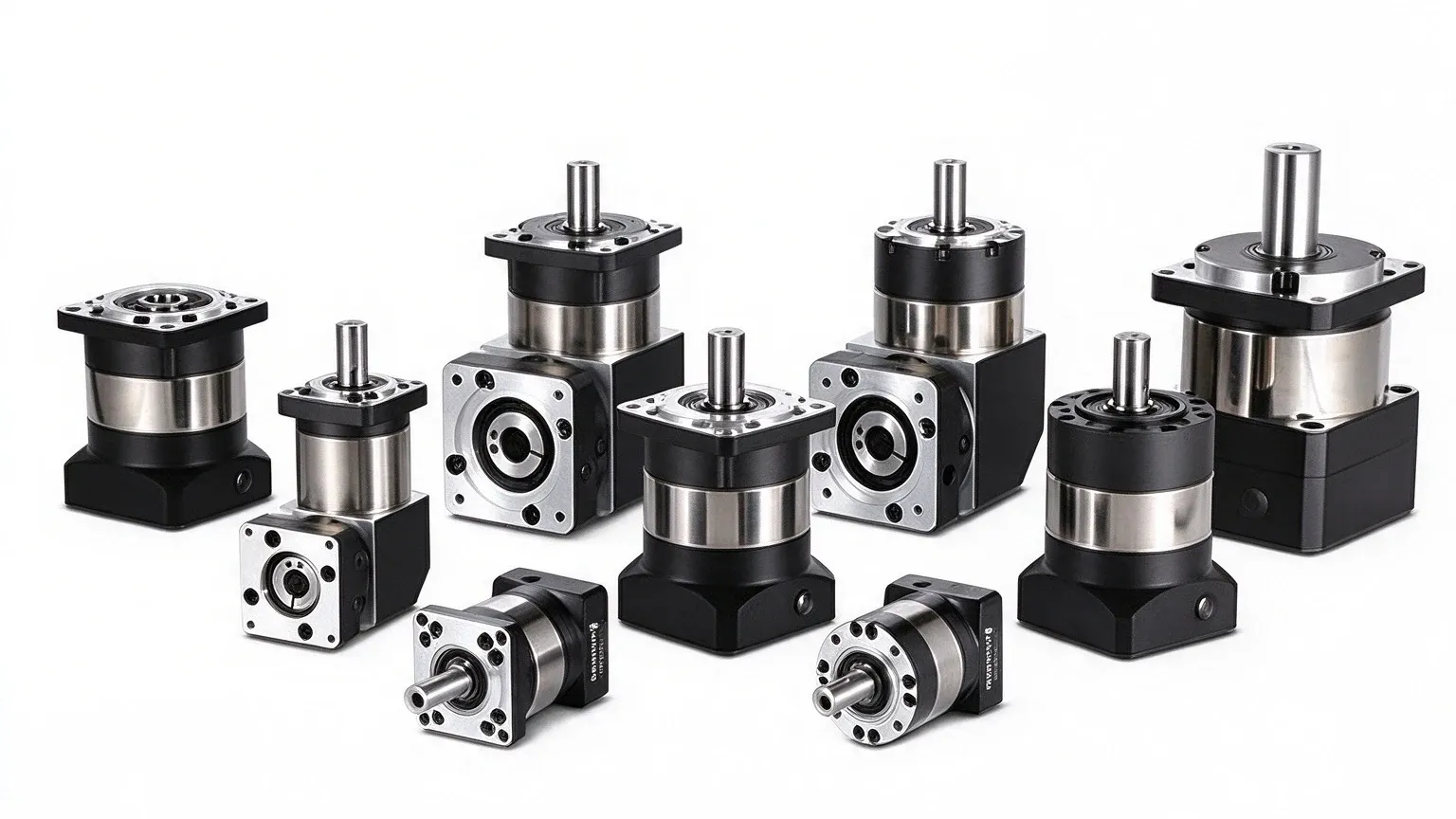
Shopping for a planetary gearbox, you will see 1 arcmin, 3 arcmin and 5 arcmin in the specification tables, and a common question follows: what do these numbers mean, and which grade does your machine actually need?
The short answer is that backlash selection starts from your positioning requirement, not from the smallest number available. A lower backlash means less internal play, but not every application needs the tightest grade.
What is backlash in a planetary gearbox?
Think of a door handle that moves a little before the latch engages. A planetary gearbox behaves the same way when the direction changes: the motor reverses, but because there is a mechanical gap between the gear teeth, the output shaft turns through a short unloaded travel before it picks up the load again.
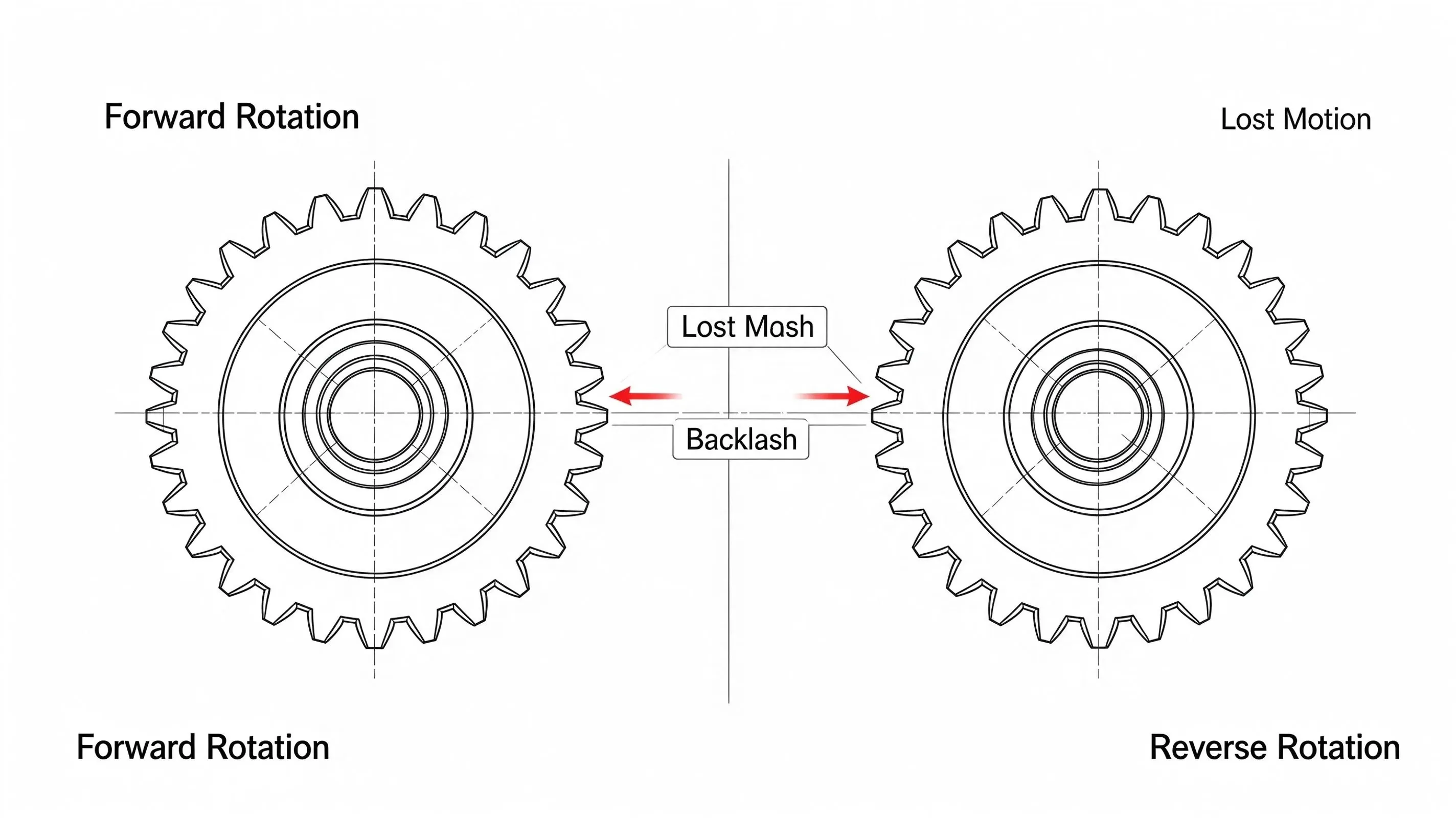
That free angular travel is backlash. It is normally expressed in arcminutes, where one degree equals 60 arcminutes.
At standard test conditions, a smaller arcmin value means a smaller free rotation at the output. The parameter matters most on machines that reverse direction often or position precisely.
What is the difference between 1, 3 and 5 arcmin?
Different automation applications tolerate different amounts of play. The ranges below are a selection reference, not a mandatory industry standard.
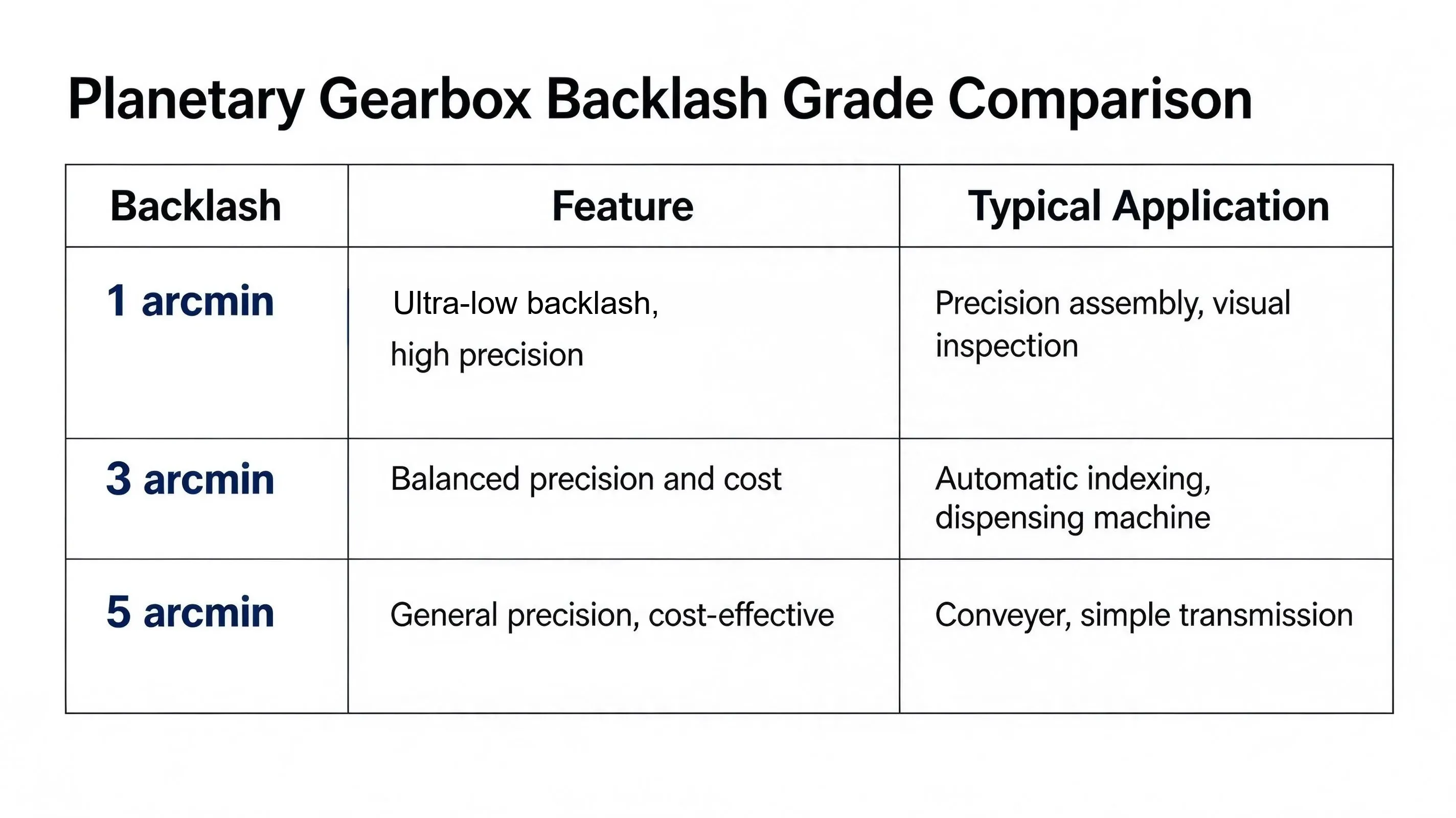
1 arcmin — ultra-high positioning accuracy, such as precision assembly stations and vision inspection, where even a small offset causes a defect.
3 arcmin — mainstream precision positioning and indexing equipment. The most widely used grade because it balances accuracy against cost.
5 arcmin — general transmission and equipment without strict repeatability requirements, such as simple conveyors and basic drive trains.
A precision assembly station is a good example: a tiny deviation causes an assembly fault, so a low-backlash model is appropriate. A simple conveyor that only has to move product does not need that accuracy, and a 5 arcmin grade is enough.
Treat the list as an initial filter rather than a final decision. Confirm the grade against your actual working conditions before you commit.
How much does backlash affect end positioning error?
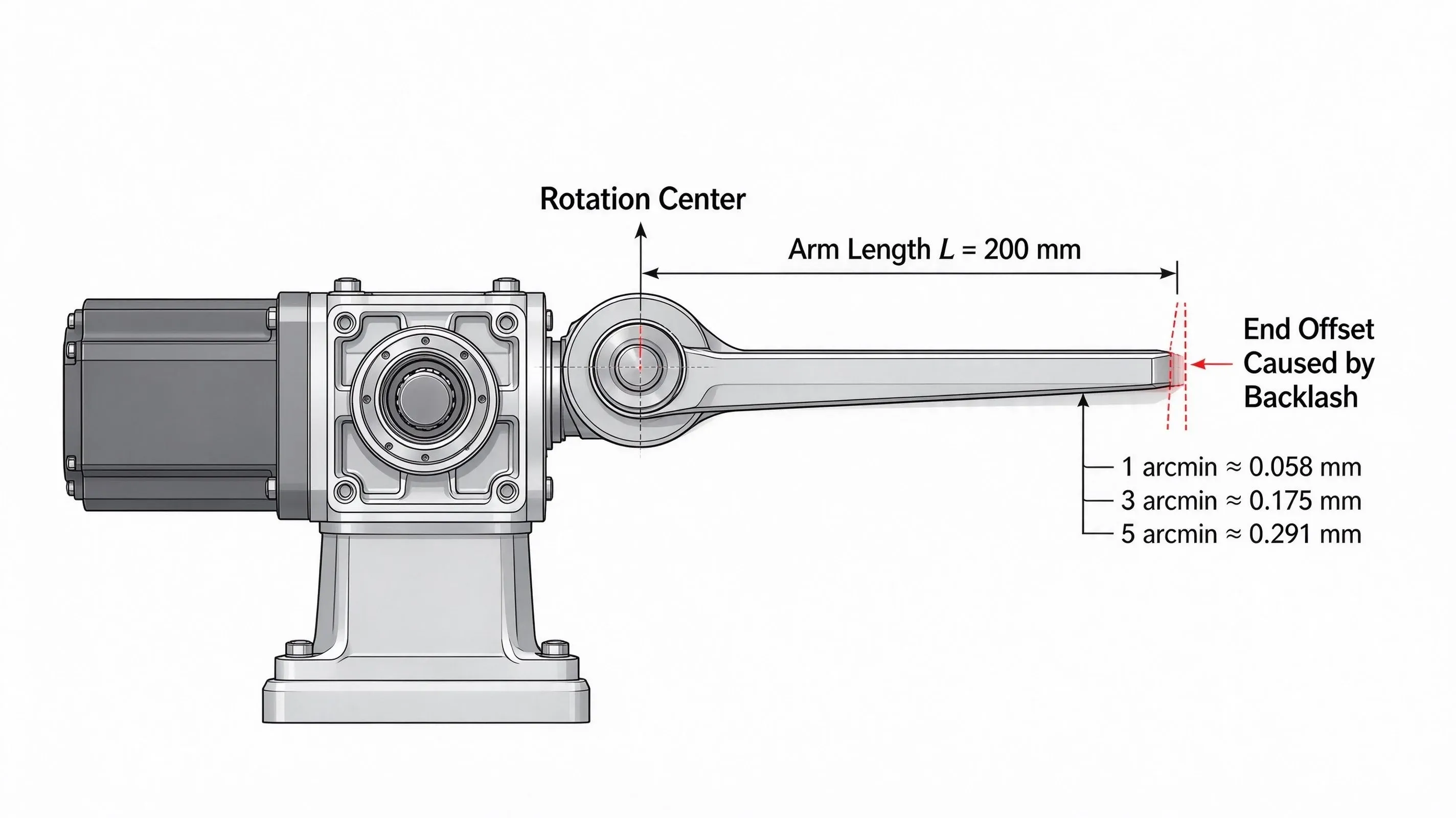
Backlash is an angular error, and on a long cantilever structure the resulting offset at the end of the arm is amplified. A simplified estimate is:
End displacement ≈ arm length × backlash angle (in radians)
Take an arm length of 200 mm. The theoretical end offset from backlash alone is about 0.058 mm at 1 arcmin, about 0.175 mm at 3 arcmin, and about 0.291 mm at 5 arcmin.
Is lower backlash always better?
No. On applications with frequent reversing and precise positioning, a low-backlash gearbox genuinely positions better, but the tighter tolerances are harder to manufacture and cost more.
If the machine has no high-accuracy positioning requirement, buying a 1 arcmin unit only raises the purchase cost with little return. Selection also has to check rated output torque, reduction ratio, servo or stepper motor matching, rigidity and mounting flange dimensions.
A very small backlash is useless if the torque cannot carry the load. The principle is to match the working conditions rather than to chase the smallest number on the datasheet.
Three questions to pick the right backlash grade
Before choosing, ask three questions about the machine.
First, does the equipment reverse direction, start and stop, or reposition back and forth frequently? The more reversals, the more backlash shows up.
Second, what positioning error can the equipment tolerate? Dispensing, vision inspection and precision assembly usually demand tight values.
Third, how long is the cantilever on the rotating mechanism? Longer arms amplify the effect.
When the answer is not clear, send the application, load, cycle time and accuracy requirement to the supplier and let an engineer check the numbers. That is far more reliable than estimating by experience alone.
Common questions
Does 1 arcmin backlash mean the machine positions to 1 arcmin?
No. Backlash is only one factor in positioning accuracy. The motor, drive, frame rigidity and assembly process all contribute to the final result.
Is a 1 arcmin gearbox always better than a 5 arcmin one?
Not necessarily. One arcmin only means less internal play. If the application does not need that accuracy, the capability is unused and the cost is wasted. A grade that meets the accuracy and load requirement is the right one.
What if I do not know which grade to choose?
Send the application, load, allowable positioning error and motor model to the supplier so the gearbox can be checked as a complete system.
Next step
Backlash selection should not start from the smallest available number. Applications with frequent reversing, precise positioning or long cantilevers benefit from a low-backlash grade, while general transmission can relax the requirement and save cost.
Torque, inertia matching and mounting dimensions matter just as much as backlash. If you have a servo motor model and the machine's working conditions, send them to us through our contact page and we will review a planetary gearbox selection. All values are finally confirmed against the product datasheet and the real operating conditions.