Oct 21, 2026Selection Guides
How to Choose a Planetary Gearbox: Ratio, Backlash and Frame Size
A practical selection guide for automation buyers: matching reduction ratio, backlash class and frame size to your servo or stepper motor application.
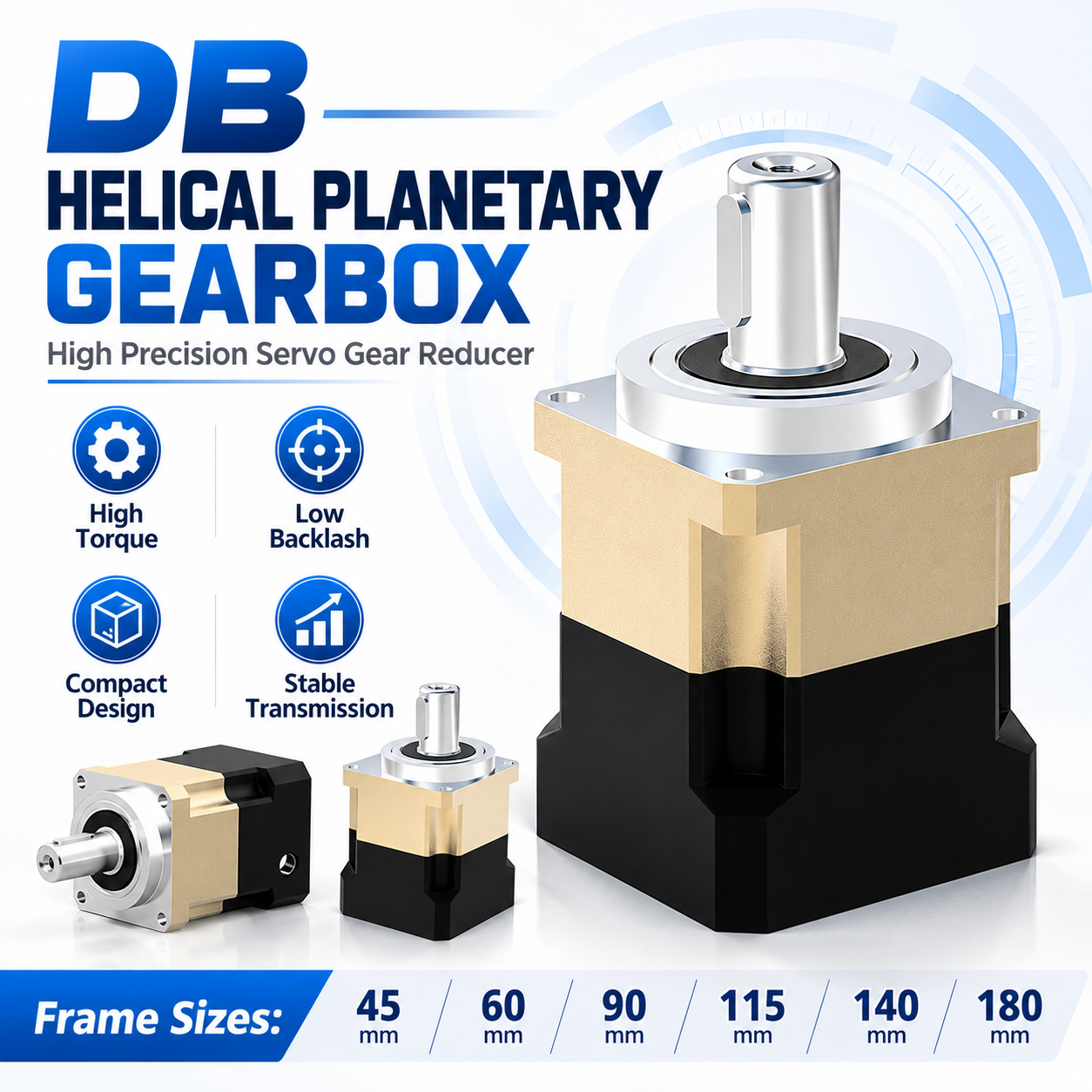
Choosing a planetary gearbox comes down to three numbers: the reduction ratio your application needs, the backlash your positioning accuracy allows, and the frame size your motor flange will fit. Get these three right and most of the remaining specification questions resolve themselves.
This guide walks through each decision in the order an automation buyer actually makes them, with the trade-offs that matter on real equipment.
Start With the Required Output Speed and Torque
The reduction ratio is the ratio between motor speed and output speed. If your servo runs at 3000 rpm and the machine needs 100 rpm at the output, the ratio is 30:1. Confirm the torque at that ratio exceeds your peak load with margin - gearbox output torque rises with ratio, but so does reflected inertia.
Ratios that land on a single stage (3, 4, 5, 7, 10) are more efficient and quieter. Ratios from 15 to 100 typically use two stages, which adds length and cost but covers the higher reduction range.
Match the Backlash Class to Your Positioning Requirement
Backlash is the small rotational play between input and output. Standard planetary gearboxes sit in a general-purpose band; precision grades for indexing and inspection work need tighter values. If the machine reverses direction frequently, backlash directly limits repeatability, so specify it explicitly rather than assuming a default.
Frame Size and Motor Flange
The frame size number (for example 60 or 90) refers to the gearbox body dimension and determines which motor flanges bolt on. Match the frame to your motor: a 60 mm frame typically pairs with 200W to 400W servo or 57 stepper motors, while a 90 mm frame handles 750W servo or 86 stepper. Verify shaft diameter, keyway and bolt circle against the drawing before ordering.
Where Each Series Fits
Straight planetary gearboxes (PF, PL) suit general servo positioning where axial length is flexible. Helical planetary gearboxes (DB, DBR, DD, DDR, DE, DER, DN, DNR) trade a little cost for smoother, quieter transmission. Right-angle versions (DBR, TR-H, TR-L) change the drive direction when machine geometry will not allow an inline motor. Harmonic drive gearboxes (CF, CFZ, SF) cover very high ratios in a compact package for robotic joints.
What to Send for a Confirmed Configuration
Provide the motor model and power, the required output speed or ratio, the frame size if already fixed, and any backlash or repeatability target. With those four inputs a gearbox can be confirmed against the drawing rather than estimated.