Oct 21, 2026Selection Guides
Harmonic vs Planetary Gearbox: Which Fits Your Application?
A side-by-side comparison of harmonic drive and planetary gearboxes on ratio range, backlash, torque density, size and cost for automation and robotics applications.
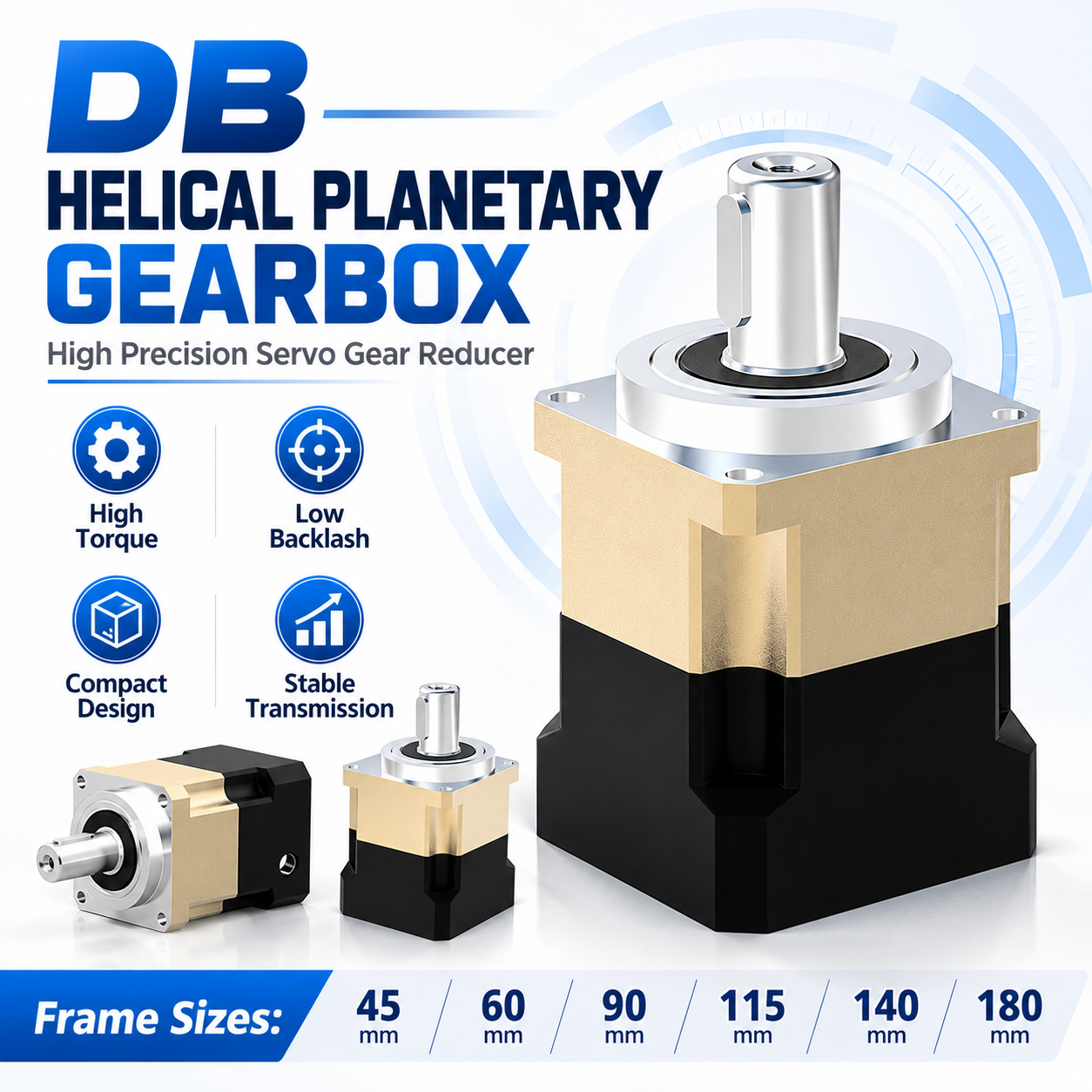
Harmonic drive gearboxes and planetary gearboxes both reduce motor speed and multiply torque, but they do it with different mechanisms and suit different applications. Choosing the wrong one shows up later as excess size, insufficient precision or unnecessary cost.
How Each Design Works
A planetary gearbox uses a sun gear driving several planet gears inside a ring gear. Load is shared across the planets, which gives high torque density in a compact radial envelope. A harmonic drive uses a flexible spline deformed by an elliptical wave generator; the small tooth difference between the flexspline and circular spline produces very high ratios in a single stage.
Ratio Range
Planetary gearboxes cover roughly 3:1 to 10:1 in a single stage and 15:1 to 100:1 in two stages. Harmonic drives deliver 30:1 to 160:1 in a single stage without stacking stages, which is why they dominate robotic joint design where axial length is tight.
Backlash and Repeatability
Harmonic drives achieve very low backlash by design because the tooth engagement is distributed across many teeth simultaneously. Precision planetary gearboxes can also reach low backlash with ground helical gearing and preloaded bearings, but the achievable value depends on the grade selected. For reversing axes with tight repeatability targets, compare the specified backlash value rather than the category.
Torque Density and Size
Harmonic drives win on ratio-per-millimeter: a compact unit delivers a very high reduction. Planetary gearboxes win on absolute torque per unit diameter at moderate ratios, because multiple planets share the load. If the application needs high torque at a moderate ratio, planetary is usually smaller and cheaper; if it needs a high ratio in a short package, harmonic is usually the only practical option.
Cost and Lead Time
Planetary gearboxes are generally lower cost at comparable torque because the manufacturing process is more conventional. Harmonic drives involve flexspline machining and specialized assembly, which raises cost. For a project where the ratio requirement is moderate, specifying harmonic drive adds expense without a functional benefit.
Matching the Choice to the Application
Robotic joints, collaborative robot arms and applications needing high ratio in a compact envelope favor harmonic drives such as the CF, CFZ and SF series. General servo positioning, indexing tables, machine tool axes and higher-torque moderate-ratio drives favor planetary gearboxes such as the DB, DD, DE, DN, PF and PL series. Right-angle variants exist in both families when machine geometry requires a direction change.
Confirming a Selection
State the required output speed, output torque, ratio, allowable backlash and available envelope. Those five inputs determine which family and frame can meet the requirement, and allow the selection to be confirmed against drawings rather than estimated.